Social Icons

Showing posts with label Oral Surgery. Show all posts

Wednesday, February 13, 2013

Painful Socket (Dry Socket)

Dry socket, the most common postoperative complication from tooth extractions is characterized by the partial or total premature loss of a blood clot that forms after extraction, exposed bone and nerves to outside, results in severe pain and delay the healing process.

In normal condition, after extraction, blood clot forms inside a socket (a hole in the bone where the tooth has been removed) and the healing process begins. During the first 24 hours, a fibrin-covered clot adheres to the socket bone.  Within 3-4 days, fibroblasts form and the clot is stabilized.  The clot is slowly replaced by granulation tissue.  In approximately 1 month, the socket is filled with new bone. 

After a Tooth Extraction: How to Take a Proper Care of Your Mouth

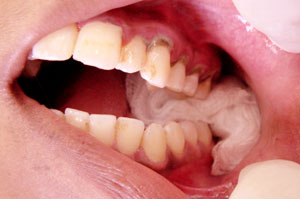
After an extraction, it's important for a blood clot to form to stop the bleeding and begin the healing process. That's why your dentist will ask you to bite on a gauze pad for 30 to 45 minutes after an extraction. If bleeding or oozing continues after you remove the gauze pad, place another gauze pad on the area and bite firmly for another 30 minutes. You may have to do this several times.

Tuesday, February 12, 2013

Submandibular Gland Resection

EMBRYOLOGY

The paired submandibular glands develop from the buds in the floor of the primitive mouth that grow on the lateral aspect of the tongue. The buds initially give rise to cords that canalize into ducts, and their ends differentiate into the acinar structures.

What to do with a knocked out tooth?

The accidental loss of a tooth is a serious situation but it can be resolved if we act quickly. Dental avulsion usually occurs after a horizontal shock which removes tooth completely out of the mouth. Following such an accident, dentists recommend these instructions in order to increase chances to keep the avulsed tooth.


Wednesday, February 6, 2013

Classification of Dental Trauma


Fig. 1  Dental Trauma

Traumatic force to the teeth or periodontium can cause destruction in a variety of direction and of a variety of magnitudes. Traumatic injuries often occur. For the sake of clarity, however, each type of injury will be describe individually.

The classification  of dental trauma used is based on the World Health Organization (WHO) classification of diseases and has been modified according to Andreasen's recommendation.